


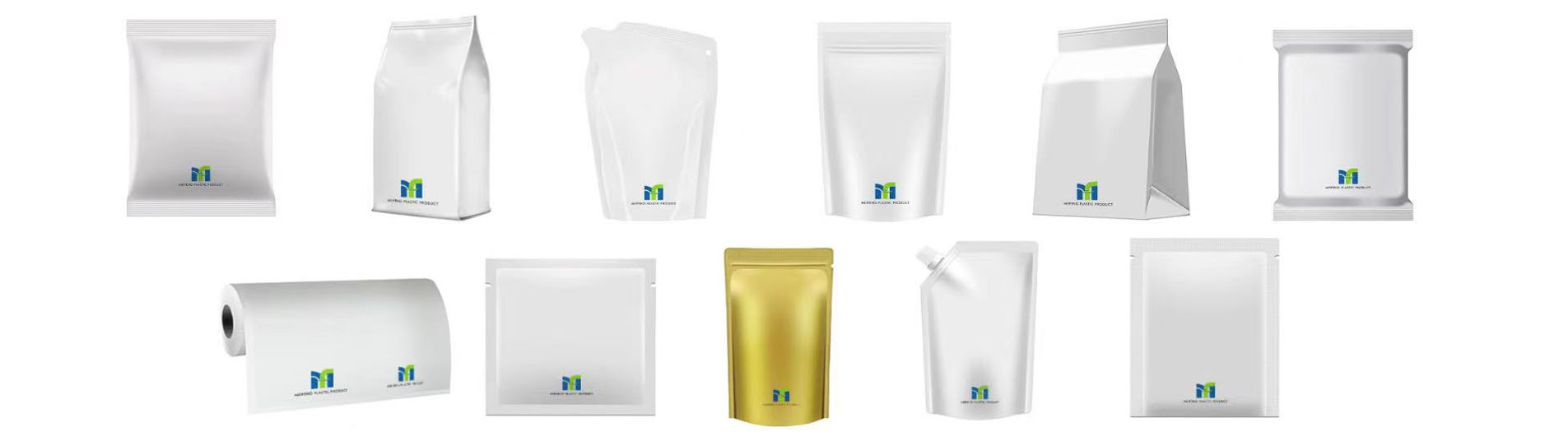
Rice Packaging Bags need to do more than simply contain grains. They must remain stable under product weight, resist punctures from hard grain edges, limit moisture entry, maintain secure seals, and support clear product presentation. Small retail packs, vacuum-packed rice, family-size bags, and larger-volume formats may all contain the same type of product, but they place very different demands on the packaging structure.
A reliable rice bag is created through the combination of material layers, bag shape, seal design, thickness, and functional features. Increasing the size of a package without adjusting these elements can result in weak bottom areas, stretched seals, unstable standing performance, or damage during handling.
For this reason, the performance of rice packaging depends on how the entire bag is designed rather than on one material specification alone.
Rice Packaging Bags Need Balanced Structural Performance
Rice has a relatively high bulk weight compared with many snacks and lightweight dry foods. As the filling volume increases, pressure becomes concentrated on the bottom seal, side seams, corners, and carrying areas of the bag.
The grain surface also matters. Individual grains may appear smooth, but repeated movement inside the package can create friction against the film. Vacuum packaging increases this pressure because the material is drawn tightly around the rice, allowing grain edges to press directly against the bag wall.
A suitable rice packaging bag should therefore provide a balance of:
- Mechanical strength
- Puncture resistance
- Moisture barrier performance
- Stable heat sealing
- Bottom and side-seam strength
- Flexibility during handling
- Suitable printing surface
- Structural stability after filling
A bag that offers excellent barrier performance but insufficient toughness may still fail during transportation. Likewise, a strong bag with poor sealing or limited moisture resistance may not provide adequate long-term protection.
How Laminated Materials Improve Rice Packaging
Many rice packaging bags use laminated film structures. Instead of relying on a single material, several layers are combined so that each one performs a specific function.
The outer layer usually supports printing, surface appearance, and mechanical strength. It helps the bag maintain a clean finish and protects the printed design from normal handling.
The middle layer may improve toughness, puncture resistance, or barrier performance. PA is often added when stronger resistance to grain pressure and vacuum stress is required. Metallized film, aluminum foil, or other barrier layers may be used when greater protection against moisture, oxygen, light, or outside odors is needed.
The inner layer normally provides heat-sealing performance and direct food contact. It must form a stable seal while remaining flexible enough to support the shape of the bag.
Common structures may include PET / PE, PET / PA / PE, PA / PE, or other customized laminated combinations. The appropriate structure depends on the bag format, rice weight, vacuum requirement, storage conditions, and expected handling pressure.
Vacuum Rice Packaging Bags Require Greater Puncture Resistance
Vacuum food packaging bags are widely used for compact rice packs. Removing air reduces the package volume and creates a firm, neat shape. It can also help reduce the movement of rice inside the bag.
However, vacuum pressure changes how the material carries the product. Once air is removed, the film fits closely around the grains. Hard grain edges and compacted corners may create concentrated pressure points.
Vacuum rice packaging bags therefore need:
- Strong puncture resistance
- Reliable side and bottom seals
- Good flexibility under compression
- A material structure that does not crack easily
- Stable sealing around compact product edges
- Consistent performance during stacking and transport
PA / PE and PET / PA / PE structures are often suitable for this type of package because the PA layer adds toughness while PE supports sealing.
The shape of a vacuum package should also be considered carefully. Sharp corners formed after vacuuming may place additional stress on outer cartons and nearby bags. Rounded corners or properly planned dimensions can improve both appearance and handling.
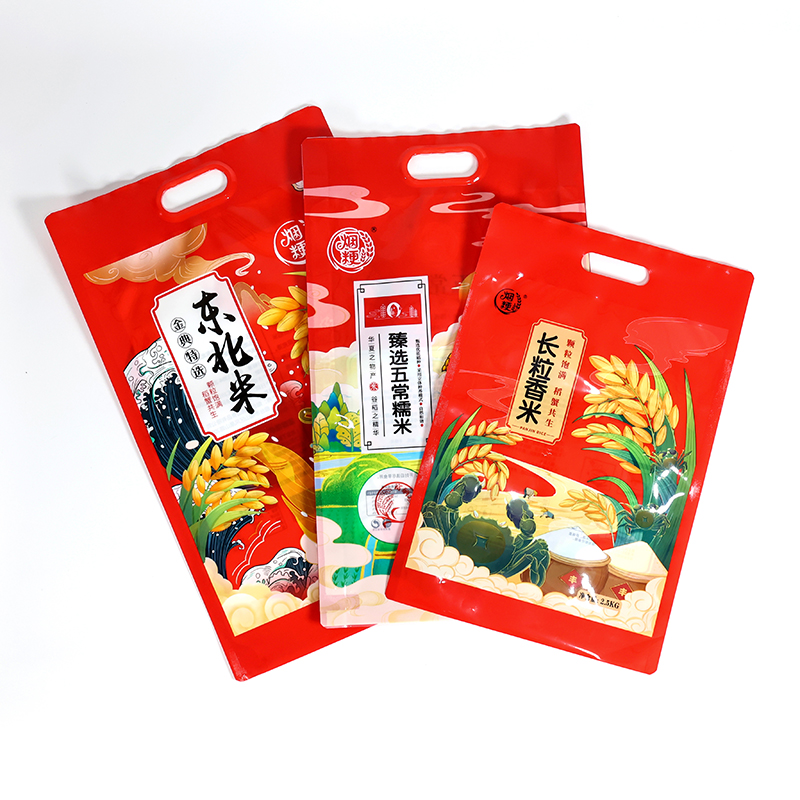
Flat Bottom Rice Packaging Bags Offer Stable Standing Performance
Flat bottom bags provide a structured shape with a wide, stable base. They are suitable for rice products that need upright shelf presentation, larger printed areas, and efficient use of internal space.
Unlike a simple flat pouch, a flat bottom bag distributes product weight across a wider base. This can improve standing stability and reduce pressure concentration when the structure is properly designed.
The front, back, and side panels provide multiple areas for:
- Brand graphics
- Rice variety information
- Cooking instructions
- Nutrition details
- Origin information
- Storage guidance
- Barcodes and labeling
Flat bottom rice packaging bags can also include zippers, handles, easy-tear features, or transparent windows. For larger formats, the bottom structure and side seams need to be reinforced to support the additional weight.
A visually attractive flat bottom bag still needs reliable mechanical performance. The base panel, corner folds, and side seals should work together as one load-bearing structure.
Stand Up Rice Pouches Combine Display and Convenience
Stand up pouches are commonly used for smaller and medium-size rice packs. Their bottom gusset allows the bag to stand independently while maintaining a flexible structure.
This format is suitable for products that need a clean shelf appearance without the more box-like form of a flat bottom bag. A zipper can be added when repeated opening is useful, while an easy-tear notch can improve first-opening convenience.
Stand up rice pouches may use:
- Full transparent film
- Partial transparent windows
- Printed laminated film
- Metallized barrier structures
- Matte or glossy surfaces
- Resealable zipper closures
The bottom gusset is one of the most important parts of this bag. It must open evenly and remain stable under the weight of the rice. If the gusset is too narrow or the bottom seals are not strong enough, the package may lean, deform, or place too much pressure on the sealed edges.
Three-Side Seal Bags Provide a Compact and Simple Structure
Three-side seal rice bags have a flat format with sealed edges on three sides. They are often used for small portions, vacuum packs, sample sizes, and compact retail packaging.
The simple structure provides a large printable surface relative to the bag size. It also allows the rice to be packed in a neat, flat shape that is easy to arrange inside cartons.
For vacuum rice applications, three-side seal bags need strong film and reliable edge seals. The side seams must resist the pressure created when the package becomes compact. The bag dimensions should also leave enough space for a secure top seal without creating excessive material around the product.
Easy-tear notches, rounded corners, and high-barrier laminated materials can be added according to the intended format.
Why the Bottom and Side Seals Matter So Much
The bottom and side seals are not only closing lines. They are structural areas that carry product weight and resist movement during transportation.
In a larger rice bag, the bottom may support several kilograms of product. If the seal width, material strength, or gusset design is unsuitable, repeated handling can weaken the structure.
Important seal-related factors include:
- Continuous and even sealing
- Adequate seal width
- Smooth corner transitions
- Strong bottom gusset construction
- Consistent laminated film thickness
- Compatibility between the sealing layers
- Resistance to compression and dropping
A thicker film does not automatically correct a weak seal design. The heat-seal layer, seal geometry, and load distribution all need to work together.
Transparent and High-Barrier Rice Packaging Serve Different Purposes
Transparent rice packaging allows the grain appearance, color, and cleanliness to remain visible. This can be useful when the product itself is an important part of the visual presentation.
However, a fully transparent structure may provide a different level of protection from an opaque or metallized laminated bag. When stronger moisture, oxygen, light, or odor barriers are required, high-barrier structures may be more suitable.
Three common approaches are available:
Fully Transparent Bags
These bags provide maximum product visibility and are suitable when visual presentation is a priority and the selected film provides sufficient protection.
Partial Window Bags
A printed or opaque bag can include a transparent window. This creates space for branding while still allowing part of the rice to be seen.
Opaque or Metallized Bags
These structures provide stronger visual coverage and may support higher barrier requirements. They are suitable when product protection is more important than complete visibility.
The choice should reflect the required balance between presentation, storage protection, and material performance.
Custom Rice Packaging Bag Options
Rice packaging bags can be developed in different formats according to product weight, display style, protection requirements, and usage conditions.
Available formats may include:
- Vacuum food packaging bags
- Flat bottom bags
- Stand up pouches
- Three-side seal bags
- High-barrier laminated bags
- Transparent rice bags
- Windowed printed bags
Customization can include bag dimensions, material structure, thickness, seal width, zipper, handle, easy-tear notch, rounded corners, transparent window, matte finish, glossy finish, and printed graphics.
The most effective rice packaging bag is not simply the thickest structure or the most complex design. It is the bag in which the material, shape, seals, and functional features work together to support the rice throughout storage, display, and transportation.
FAQ
1. What materials are commonly used for Rice Packaging Bags?
Common structures include PET / PE, PA / PE, PET / PA / PE, and other laminated films. The appropriate material depends on bag size, vacuum requirements, barrier performance, and structural strength.
2. Which bag format is suitable for vacuum-packed rice?
Three-side seal vacuum bags and other vacuum food packaging bags are commonly used. They should provide strong puncture resistance, reliable seals, and enough flexibility to fit closely around the rice.
3. Are flat bottom bags suitable for rice packaging?
Yes. Flat bottom bags provide stable standing performance, efficient internal space, and multiple printable panels. They are suitable for retail rice products that require a structured appearance.
4. Is transparent packaging always suitable for rice?
Transparent packaging is useful for displaying grain quality, but it may not always provide the same barrier level as opaque or metallized structures. The final choice should balance product visibility with moisture, oxygen, light, and odor protection.
Post time: Aug-04-2026