


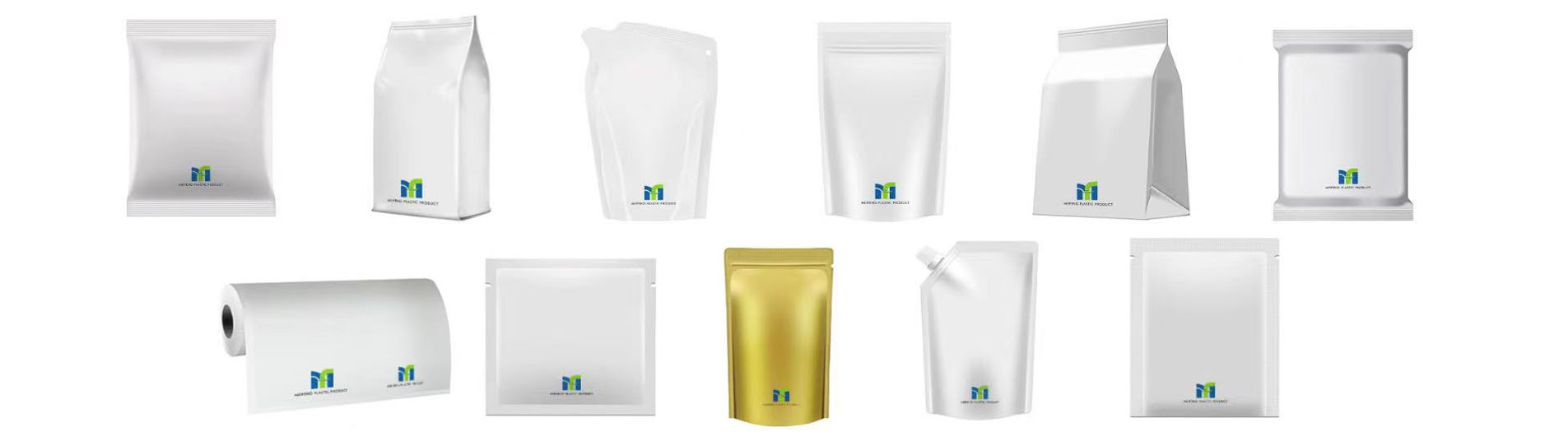
Pet Food Packaging Bags need to do more than hold a fixed weight of dry food. The size, hardness, shape, surface texture, and oil content of kibble can all change how the bag is stressed during storage and handling. Two pet food products with the same net weight may therefore require different pouch dimensions, film structures, sealing strength, and barrier performance.
Large round kibble behaves differently from small dense pellets. Sharp-edged pieces can press against the film more aggressively, while oily formulas place greater demands on oxygen and aroma protection. For this reason, pet food packaging should be matched to the physical form of the product rather than selected by weight alone.
Pet Food Packaging Bags for Small and Dense Kibble
Small kibble usually packs more tightly because the pieces leave less empty space between them. This means a relatively compact Pet Food Packaging Bag may hold a higher product weight than a bag used for larger, irregular pieces.
Dense kibble creates several structural considerations. More weight can concentrate toward the lower part of the pouch, increasing stress on the bottom and lower side seals. The bag therefore needs sufficient mechanical strength and stable sealing, especially in medium- and large-volume formats.
For small, dense kibble, the packaging structure often needs to balance:
- efficient internal volume;
- stable bottom and side seals;
- adequate film strength;
- moisture protection;
- oxygen barrier for fat-containing formulas.
The bag should also retain enough flexibility to conform around the product without becoming excessively rigid.
Large Kibble Needs More Internal Volume
Large kibble pieces leave more air space between individual pieces. Even when the total product weight is unchanged, the required package volume can be noticeably larger.
This is why bag dimensions should not be determined only by kilogram or gram capacity. Width, height, gusset depth, and bottom expansion all influence how comfortably large kibble fits inside the pouch.
If the internal space is too limited, the pieces can press harder against the side panels and seals. Excessive pressure may distort the pouch shape or increase local stress around gussets and corners.
For larger kibble, Pet Food Packaging Bags often benefit from:
- deeper gussets;
- more usable internal volume;
- sufficient top sealing space;
- good flexibility around irregular product surfaces;
- stronger lower bag construction for larger pack weights.
The objective is not simply to make the bag larger, but to create enough three-dimensional space for the kibble to settle naturally.
Sharp or Irregular Kibble Changes the Puncture Risk
Not all dry pet food has smooth edges. Some pieces have corners, pointed shapes, hard baked surfaces, or irregular geometry. These forms can create repeated local pressure against the inner surface of the packaging.
A film structure that performs well with smooth pellets may not provide the same protection against sharper kibble.
For irregular or hard-edged pet food, the bag should place greater emphasis on toughness and puncture resistance. PA-containing laminates can be used when additional mechanical reinforcement is required, while the overall film thickness should remain balanced with flexibility.
The key areas of concern include:
- side gusset folds;
- bottom corners;
- lower seals;
- areas where hard pieces repeatedly contact the film.
Puncture resistance should therefore be considered together with the product shape, not only with the total bag weight.
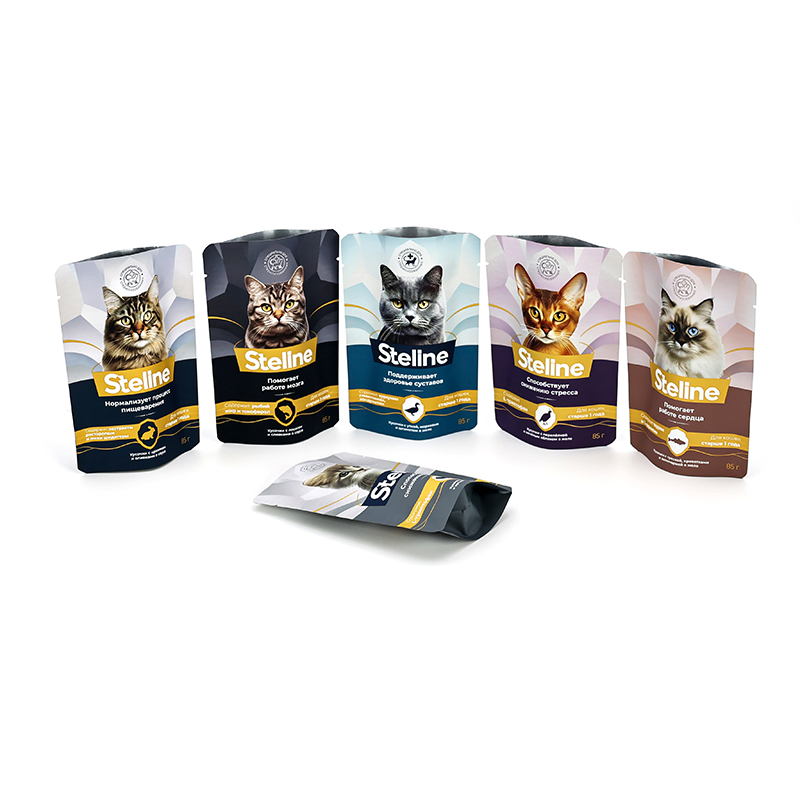
Surface Texture Influences Film Contact
Kibble surface texture also affects how the product interacts with the inside of the bag.
Smooth pellets tend to slide more easily and create less friction. Rough, baked, coated, or highly textured pieces can create more repeated contact with the film during movement and transportation.
For these products, Pet Food Packaging Bags may require better resistance to abrasion and flexing. A stronger laminate can help the film maintain integrity even when the contents move repeatedly against the pouch walls.
The internal film should also remain smooth and stable so that surface contact does not weaken the laminated structure over time.
This is especially relevant in larger bags, where the total product weight increases the pressure between kibble and the bag surface.
High-Fat Kibble Requires More Than Mechanical Strength
Physical shape is only one part of the packaging requirement. Many pet food formulas contain oils and fats that make oxygen protection more important.
Fat-rich kibble can be sensitive to oxidation, which may affect aroma, flavor, and overall product condition. In these cases, the packaging structure needs to combine mechanical strength with suitable oxygen and aroma barriers.
Possible structures may include:
- PET / PE for basic flexible protection;
- PET / PA / PE for improved toughness;
- PET / VMPET / PE for stronger oxygen and moisture protection;
- PET / AL / PE for high-barrier opaque packaging.
The appropriate structure depends on both the kibble form and the required protection level. A hard, oily kibble may need puncture resistance and high barrier performance at the same time.
This is why the laminate should be evaluated as a complete system rather than by one material or one thickness value.
Pet Food Packaging Bags Must Match Bulk Density
Bulk density is one of the most useful factors when determining pet food bag size.
Two pet foods can have the same weight but occupy very different volumes because of differences in kibble size, shape, and internal air space. A dense 5 kg product may fit into a more compact pouch, while a lighter, larger kibble may require a deeper or taller bag.
This relationship can be summarized simply:
| Kibble Characteristic | Effect on Bag Design |
|---|---|
| Small, dense pieces | Higher weight in less volume |
| Large pieces | More internal volume required |
| Irregular shapes | More uneven pressure on bag walls |
| Sharp edges | Higher puncture-resistance requirement |
| Rough surface | Greater abrasion and flexing demand |
| High oil content | Stronger oxygen and aroma barrier needed |
Because of this, “5 kg pet food bag” should not be treated as one universal pouch size. The correct dimensions depend on the actual product volume and shape.
Bag Format Also Changes with Kibble Characteristics
Different Pet Food Packaging Bags can use different pouch formats depending on capacity and product behavior.
Flat bottom bags provide a broad base and structured shape, making them suitable for products that benefit from stronger standing stability and larger printable surfaces. Side gusset bags provide additional expansion space and work well for medium- and larger-capacity pet food. Stand-up pouches can be suitable for smaller packs and pet treats, especially when resealability is important.
The most suitable format depends on how the kibble fills the available space and how much weight the bag needs to support.
For heavier or bulkier products, gusset dimensions and bottom construction become increasingly important. For smaller snacks or treats, zipper position, opening width, and compact size may become more relevant.
Closure Features Should Match Product Size and Reuse
Resealable zippers are common in Pet Food Packaging Bags, particularly for products that are opened repeatedly.
The zipper position should leave enough space for the product below and a reliable top seal above. Large kibble may require a wider opening so pieces can move through the bag mouth more easily, while small kibble can work with a more compact opening.
Larger bags may also use carrying features such as handles. These areas should be integrated into the bag structure carefully because pulling force is concentrated around the handle opening.
Closure and carrying features should therefore be considered part of the complete bag design rather than separate accessories.
Pet Food Packaging Bags Should Be Designed Around the Product Form
The physical form of pet food has a direct influence on packaging performance.
Small dense kibble changes weight distribution. Large pieces increase volume requirements. Sharp or irregular shapes increase puncture risk. Rough surfaces create more film contact, while high-fat formulas increase the need for oxygen and aroma protection.
A suitable Pet Food Packaging Bag brings these factors together through the right combination of bag dimensions, laminate structure, gusset design, seal strength, barrier performance, and closure format.
The result is not one standard pouch for every pet food product, but a packaging structure that reflects how the kibble actually behaves inside the bag.
FAQ
1. Does kibble size affect pet food packaging bag dimensions?
Yes. Larger kibble usually requires more internal volume because there is more air space between pieces, while smaller dense kibble may fit into a more compact bag.
2. What type of pet food packaging bag is suitable for sharp kibble?
Sharp or irregular kibble benefits from stronger puncture-resistant laminated structures, such as those containing PA, together with stable side and bottom seals.
3. Why do high-fat pet foods need stronger barrier packaging?
Higher fat content can increase sensitivity to oxygen and aroma changes, so stronger oxygen and moisture barriers may be required.
4. Can two 5 kg pet foods use different bag sizes?
Yes. Product weight alone does not determine bag size. Bulk density, kibble shape, piece size, and the amount of internal air space all affect the required packaging volume.
Post time: Aug-18-2026