


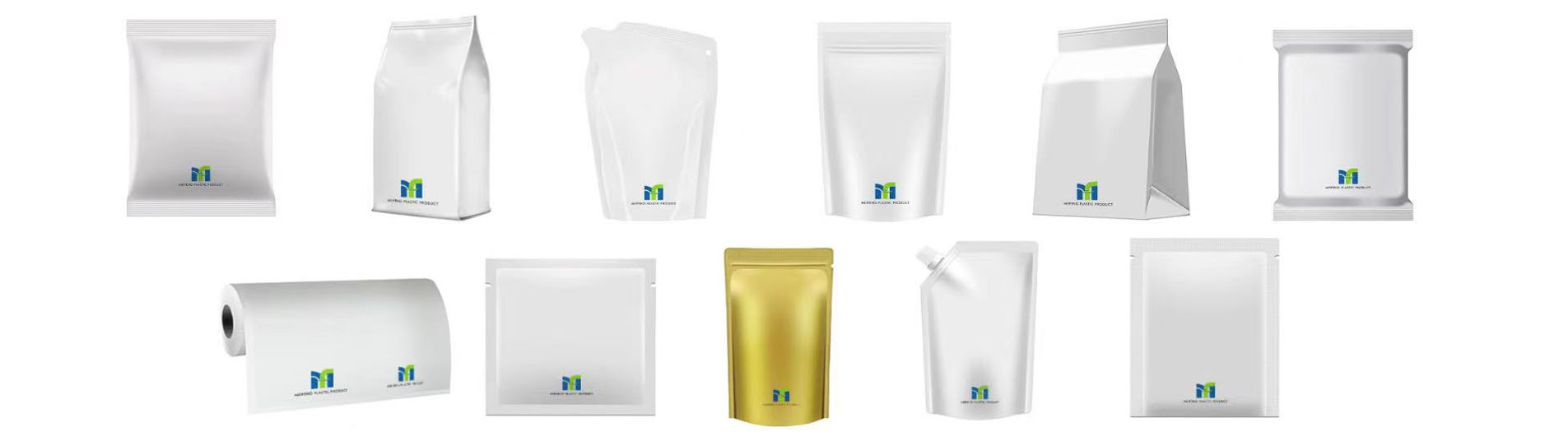
Choosing the right Food Packaging Roll Film Supplier involves more than specifying a film width and printing artwork. Food packaging roll film needs to work as a complete flexible packaging material, with the right structure, surface properties, printed layout, roll dimensions, and consistency for the final packaging application.
Coffee, snacks, powders, frozen foods, pet food, and other products do not necessarily use the same roll film construction. Some applications require stronger moisture or aroma protection, while others place more emphasis on low-temperature flexibility, printed appearance, or stable film handling. For this reason, a reliable Food Packaging Roll Film Supplier should be able to develop roll stock around the actual food product rather than offering one standard laminate for multiple applications.
Food Packaging Roll Film Should Start with the Final Package Requirement
Roll film is often supplied as a flexible packaging material before it becomes the final food package, so its specification needs to anticipate what will happen later in the packaging process.
The material needs to match the intended package format, film direction, printed layout, sealing area, and finished dimensions. A roll film that looks correct as a flat printed material may still create problems if the print repeat, seal layer, or roll specification does not match the final application.
Before defining the roll film, several factors usually need to be considered together:
- food type and storage conditions;
- required package size;
- transparent, metallized, or opaque appearance;
- printed or unprinted structure;
- sealing requirements;
- roll width and roll diameter;
- artwork repeat length and registration;
- final package format.
This is why food packaging roll stock is more than simply “printed film on a roll.” The entire specification needs to connect the material with the finished package.
Different Foods Need Different Food Packaging Roll Film Structures
The same roll film structure is not suitable for every food category.
Snack packaging may require a lightweight structure with good print appearance and moisture control, while coffee packaging may need stronger protection against oxygen and aroma loss. Powder products often place greater emphasis on moisture protection and clean sealing, while frozen food packaging needs film that remains suitable in low-temperature environments.
Pet food can create another set of requirements, especially when the product contains oil, strong aroma, or irregular particles. In these applications, the roll film needs to balance protection, toughness, and sealing performance.
A useful way to define the structure is to start with the main product risk rather than the material name.
| Food Application | Main Roll Film Priority |
|---|---|
| Snacks | Moisture protection and print appearance |
| Coffee | Aroma and oxygen protection |
| Powder food | Moisture protection and clean sealing |
| Frozen food | Low-temperature flexibility and toughness |
| Pet food | Aroma, oil resistance, and mechanical strength |
| Dry food | Stable storage and practical film handling |
The goal is not automatically to use more layers or greater thickness. It is to develop a structure that fits the food and the final packaging conditions.
Printed Roll Film Needs More Than Good Artwork
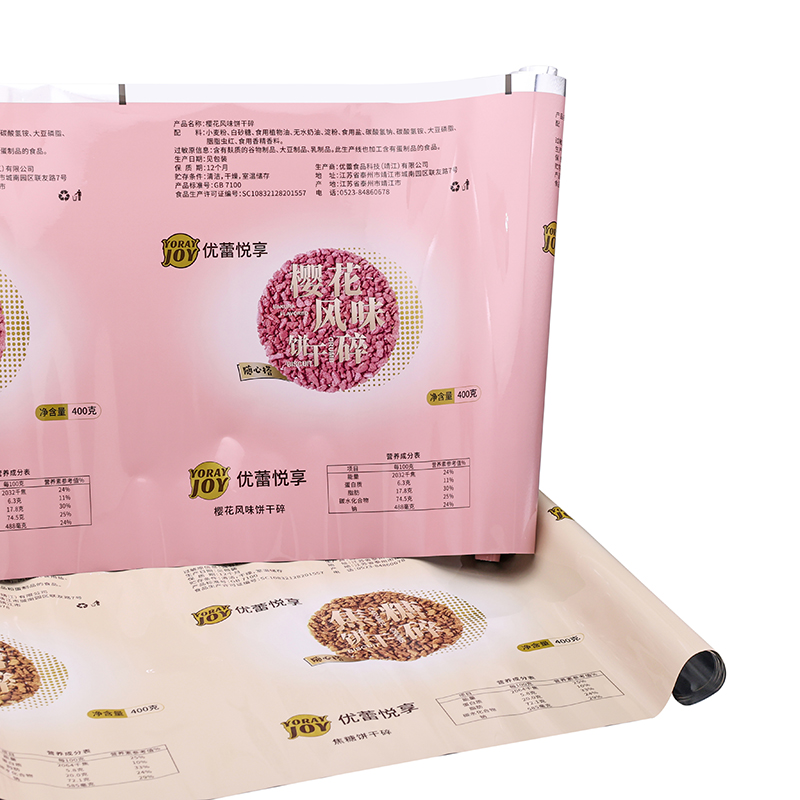
For Custom Printed Food Packaging Roll Film, the visual design needs to work with the repeat length, package dimensions, sealing areas, and final cutting position.
A graphic file can look perfect on screen but still appear incorrectly positioned if the print repeat does not match the final package dimensions. Small errors in registration can become more visible when repeated across a long roll, especially where logos, windows, or product names need to remain aligned with the finished package.
Printed roll film therefore requires control over both design and production. Important factors include artwork repeat, color consistency, registration accuracy, edge position, and roll tension.
For food brands with multiple SKUs, the printing method also matters. Shorter runs may benefit from digital printing, while larger and more stable projects may be more suitable for gravure printing.
Roll Width and Diameter Affect More Than Material Quantity
Roll width, core size, outer diameter, and total roll length are practical parts of the finished specification. They influence storage, handling, and how the material is used later.
A wider roll does not automatically improve efficiency, just as a larger roll is not always preferable. The roll needs to match the downstream packaging requirement and the way the material will be handled.
For this reason, a Food Packaging Roll Film Supplier should confirm roll dimensions together with the film structure and printed layout rather than treating them as secondary details.
Consistency is also important. Variations in roll width, edge quality, or winding condition can affect the way the material behaves during later use. Stable roll formation therefore becomes part of the finished product quality.
Mfirstpack Supports Different Food Packaging Roll Film Applications
Mfirstpack provides flexible packaging roll stock for different food applications in addition to finished pouches. The roll film can be developed around the actual product, printed design, material structure, and final packaging requirement.
Food packaging roll film can be customized for products such as coffee, snacks, powders, frozen foods, pet food, rice, nutritional products, and other dry or processed foods. Depending on the application, the structure can be adjusted for transparency, barrier performance, toughness, appearance, and sealing requirements.
This allows the roll stock to be developed as part of the complete package rather than as an isolated material specification.
Digital and Gravure Printing Support Different Project Sizes
Mfirstpack combines digital and gravure printing so that printed roll film can be matched to different production stages.
For smaller quantities, new product launches, seasonal designs, or multiple SKUs, HP Indigo 20000 digital printing provides greater flexibility. It can reduce the need for traditional plate making and is suitable for projects where artwork changes more frequently.
For larger and more stable production programs, high-speed gravure printing provides another option for consistent printed flexible packaging.
This combination is useful because food packaging projects do not always remain at the same scale. A project may begin with a short-run test and later move into a larger production program. The printing method can then be adjusted without changing the entire packaging concept.
Film Production and Lamination Support Custom Roll Stock Development
Food packaging roll film performance depends on more than the printed surface. The base film and laminate structure also need to be controlled consistently.
Mfirstpack operates film extrusion, printing, lamination, slitting, and flexible packaging production within its manufacturing system. W&H film extrusion capability supports customized PE film development, while Nordmeccanica solvent-free lamination is used for multilayer flexible packaging structures.
This makes it possible to consider film thickness, laminate balance, printed surface, and finished roll specifications together.
When a project requires a different film structure, the adjustment can be evaluated in relation to the final roll stock rather than as an isolated material change.
Slitting and Winding Quality Matter in Food Packaging Roll Film
After printing and lamination, roll film still needs to be converted into the required width and winding format.
This stage is easy to overlook, but poor edge quality, uneven winding, or inconsistent roll tension can reduce the quality of the finished roll even when the printed film itself is acceptable.
A well-finished roll should maintain clean edges, consistent width, stable winding, and a roll structure suitable for handling and later use. These characteristics help the material remain predictable from the beginning to the end of the roll.
For long production runs, consistency between rolls is also important. The first roll and the last roll should follow the same specification rather than showing noticeable differences in width, print position, or winding condition.
Mfirstpack Quality Control Covers Material and Finished Roll Performance
Food packaging roll film should not be evaluated only by print appearance. Material strength, layer bonding, friction behavior, sealing performance, and roll consistency also contribute to the final result.
Mfirstpack’s quality control system includes inspection during production as well as laboratory testing. Depending on the packaging project, testing can include tensile properties, interlayer adhesion, seal strength, friction, puncture resistance, and other relevant performance checks.
These tests help connect the material specification with the way the finished roll is expected to perform.
For printed roll stock, visual inspection also remains important because color, registration, and surface defects can repeat throughout an entire roll. Combining visual inspection with material testing provides a more complete approach to quality control.
Food Packaging Roll Film Can Be Customized Around the Project
A practical roll film specification often combines several variables rather than changing only one parameter.
Mfirstpack can develop food packaging roll stock around:
- film width and roll dimensions;
- material and laminate structure;
- transparent, metallized, or opaque appearance;
- custom printing and multiple SKUs;
- print repeat and artwork layout;
- sealing-layer requirements;
- film thickness;
- surface finish;
- application-specific packaging needs.
This flexibility is useful because a new snack product, coffee line, frozen food package, or pet food project may require very different roll stock even when the finished packages appear similar in size.
From Food Product to Finished Roll Film
A professional Food Packaging Roll Film Supplier should be able to connect the food product, material, printing, lamination, slitting, and finished roll specification into one development process.
Mfirstpack combines flexible film production, digital and gravure printing, solvent-free lamination, slitting, testing, and food packaging experience to support different roll-stock projects. This allows material, print design, and roll dimensions to be adjusted around the final application rather than defined separately.
The result is not simply a printed roll of flexible material, but a roll film specification developed for the food product and its final packaging requirements.
Need Custom Food Packaging Roll Film?
If you are developing new Food Packaging Roll Film or need to adjust an existing packaging structure, Mfirstpack can support the project from material and printing selection through lamination, slitting, and finished roll production.
To start a roll film project, provide the available information about your food product, required film width, current material structure, artwork, roll specifications, and expected quantity. If some specifications are not yet finalized, the packaging structure can be discussed according to the product and final application.
Contact Mfirstpack to discuss a custom food packaging roll film solution for your project.
FAQ
1. What types of Food Packaging Roll Film can Mfirstpack provide?
Mfirstpack can provide customized printed and unprinted flexible packaging roll films for food, pet food, coffee, powders, snacks, frozen products, and other applications.
2. Can Food Packaging Roll Film be custom printed for multiple SKUs?
Yes. Digital printing can support smaller-volume and multi-SKU projects, while gravure printing is available for larger and more stable production programs.
3. What information is useful for developing custom roll film?
Useful information includes the food type, film width, current or target material structure, artwork, print repeat, roll dimensions, expected quantity, and final packaging application.
4. Can the roll film material structure be customized?
Yes. The structure can be adjusted according to protection requirements, appearance, sealing needs, film thickness, and the intended food application.
Post time: Sep-12-2026