


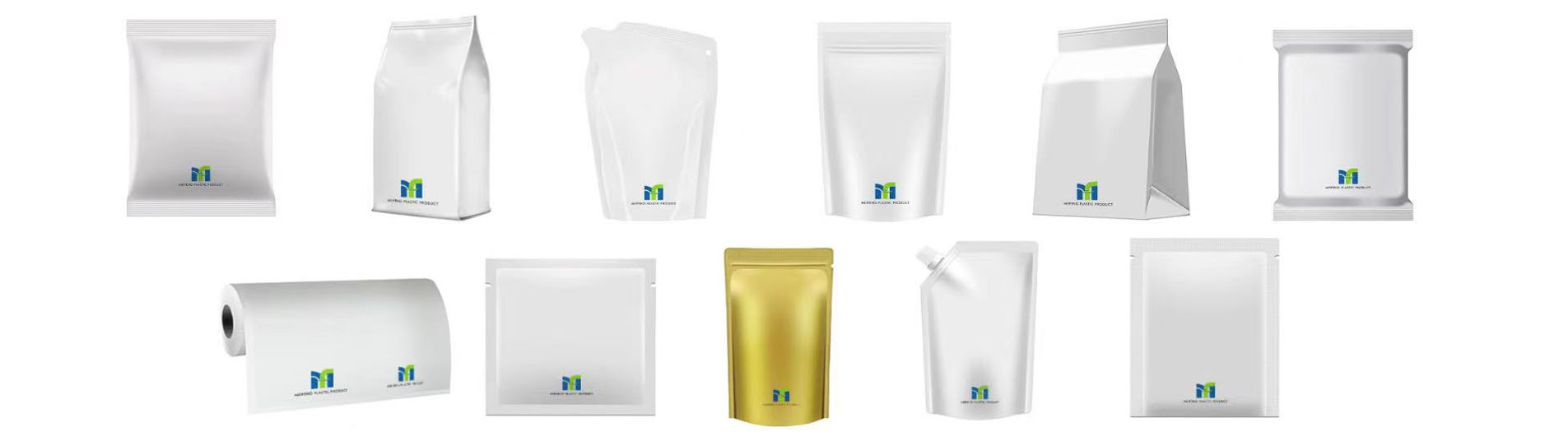
Choosing the right Food Packaging Bags Supplier means more than finding a company that can produce stand-up pouches, flat bottom bags, or three-side seal bags. Different foods vary in shape, weight, storage environment, frequency of use, and presentation requirements, and these differences directly affect pouch format, material structure, printing method, and functional design. Coffee packaging may focus on aroma retention and appearance, powder products may require stronger moisture protection, rice and dry pet food need greater attention to package strength, while meat and seafood may be better suited to vacuum packaging that follows the product shape.
A professional Food Packaging Bags Supplier should therefore start with the food itself and develop the pouch format, material, dimensions, printing, and functional features as one complete packaging solution. Mfirstpack provides stand-up pouches, flat bottom bags, side gusset bags, three-side seal bags, vacuum bags, spout pouches, and flexible packaging roll films, with structures that can be adjusted according to the actual food product and final packaging requirements.
A Food Packaging Bags Supplier Should Match the Pouch Format to the Food
There is no single pouch format that works equally well for every food application. A small snack package and a large rice bag solve very different packaging problems even though both belong to flexible packaging. Snacks and smaller products often place more emphasis on easy opening, front-facing presentation, and resealable features, while rice, dry pet food, and other heavier products need a package that remains stable during handling, stacking, and storage.
Different pouch formats also serve different purposes. Stand-up pouches provide a clear front-facing panel and are suitable for snacks, powders, pet treats, and many everyday food products. Flat bottom bags create a more defined multi-panel structure and are often used for coffee, pet food, and products where package shape is part of the presentation. Three-side seal bags keep the package flat and compact, while vacuum bags fit more closely around meat, seafood, and other solid foods. Side gusset and spout pouch formats provide additional options for products with different capacities and usage requirements.
Mfirstpack therefore does not limit food packaging to a few standard bag formats. The pouch structure can be matched more closely to the product form and the desired finished package.
Food Packaging Bags Should Not Be Defined by Thickness Alone
Once the pouch format is selected, the material structure also needs to match the characteristics of the food. Two stand-up pouches may look almost identical from the outside while using completely different laminate structures because the products inside have different requirements.
Nuts, coffee, powders, pet treats, and frozen foods do not face the same packaging conditions. Some products are more sensitive to moisture, while others require greater attention to oxygen, aroma, light exposure, oil content, or low-temperature performance. Transparent structures can be used when the food itself should remain visible, while metallized, aluminium foil, or other opaque structures are more suitable when greater light shielding or a fully covered appearance is preferred.
The goal is not simply to increase thickness or add more layers. A useful material structure should provide the protection needed by the actual product while maintaining suitable handling, appearance, and pouch performance. For a Food Packaging Bags Supplier, the more valuable capability is being able to coordinate the food characteristics, pouch format, and material construction together.
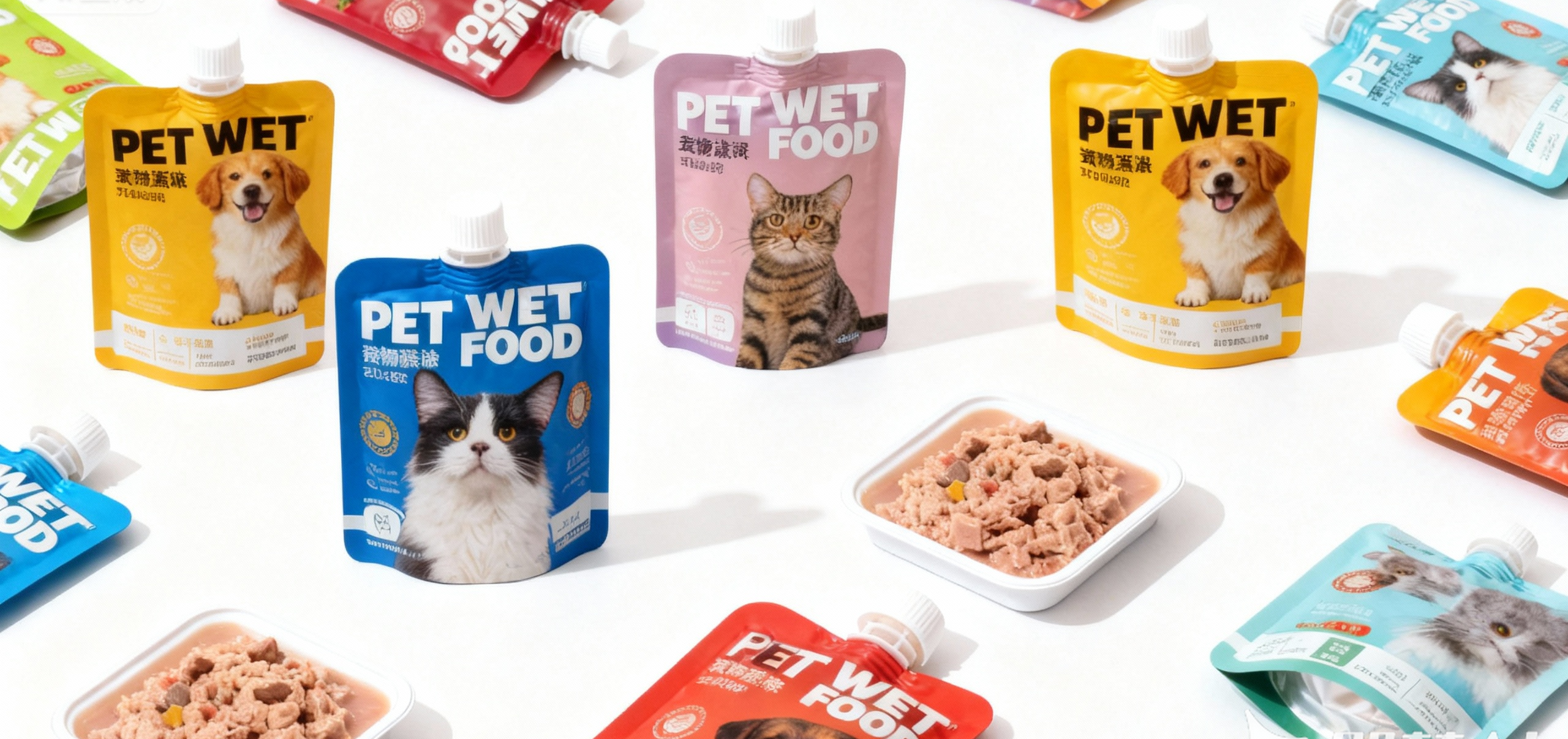
Custom Food Packaging Bags Involve More Than Adding a Logo
Custom food packaging should not be limited to changing the dimensions, colors, or printed artwork. A complete Custom Food Packaging Bags project also needs to consider how the package will be opened, carried, stored, and used.
Depending on the food and application, different functional features can be added:
- Resealable zippers for snacks, pet food, and dry foods that are opened repeatedly;
- Transparent windows to show product color, texture, or particle size;
- Handles for larger packages that need to be carried frequently;
- Tear notches or laser scoring to improve first opening;
- Spouts for sauces, liquids, and semi-liquid foods;
- Matte, glossy, or other surface finishes to create different visual effects.
These features need to be planned together with the pouch structure. A zipper reduces usable top space, a window changes both the material configuration and artwork area, and a handle needs to work with package weight and stress distribution. For this reason, Mfirstpack develops pouch format, materials, printing, and functional features together rather than adding them separately to a standard bag.
Mfirstpack Supports Different Food Packaging Printing Requirements
Food brands often need very different printing quantities during product development and stable production. A new product may need several SKUs or different packaging versions for testing, while a mature product line usually places more emphasis on consistency and larger production volumes.
Mfirstpack supports both digital and gravure printing. The HP Indigo 20000 digital printing system is suitable for short runs, multiple SKUs, and projects where artwork may change frequently, reducing the limitations associated with traditional plate making. Suitable projects can begin at relatively small quantities and combine several SKU designs within one program. For larger and more established production runs, high-speed gravure printing provides a more appropriate solution.
The value of offering both methods is not simply having more equipment. It allows the printing approach to change with the development stage of the product. A food packaging project can move from small-volume market testing toward stable production without rebuilding the entire packaging process.
From Film to Finished Pouch, Food Packaging Development Stays Connected
A finished food pouch may look simple, but its production involves film, printing, lamination, slitting, and bag making. If these stages are treated separately, problems can appear even when each individual process seems acceptable. Artwork may look correct on screen but shift after folds and zippers are added; a material specification may appear suitable but produce a different pouch feel than expected; or a sample may perform well while larger production runs show greater variation.
Mfirstpack has capabilities covering film production, printing, lamination, slitting, and pouch making, allowing these stages to be coordinated around the finished package. When a material structure changes, its effect on later bag-making stages can also be considered. When the pouch shape is adjusted, artwork placement, fold positions, and final panel appearance can be reviewed at the same time.
For customized Food Packaging Bags, this connected production system helps reduce the gap between material design, printing, and the final pouch.
Mfirstpack Develops More Than Existing Food Packaging Formats
Flexible food packaging continues to change not only in graphic design but also in material structure and daily usability. As simpler and more recyclable material systems become more important, Mfirstpack has been developing BOPE/PE mono-material-oriented structures for applications such as rice, snacks, nuts, and other products across different package sizes and weights.
Functional development is also part of the packaging approach. Mfirstpack has developed an external handle solution for flat bottom bags used for medium and heavier flexible packages. For larger packages, the handle is not simply a decorative feature; it directly affects how the package is carried and used.
This means custom packaging development can extend beyond artwork and dimensions to include material direction, pouch structure, and practical functionality.
Food Packaging Quality Cannot Be Judged by Appearance Alone
A pouch that looks smooth and well printed immediately after production does not automatically guarantee stable performance during transport and use. Food packaging may experience drops, pressure, friction, repeated handling, sealing stress, and pressure from the product inside, so finished appearance represents only part of the package performance.
Mfirstpack’s quality control includes online and offline inspection as well as testing for seal strength, tensile properties, interlayer adhesion, puncture resistance, drop resistance, burst strength, vacuum performance, and friction. Third-party testing can also be coordinated when a project requires additional verification.
The company also holds BRCGS Packaging and Packaging Materials certification and ISO 9001:2015 quality management certification. For food and pet food packaging, these systems provide a more structured basis for maintaining consistency from material preparation through printing, lamination, and finished pouch production.
A Food Packaging Bags Supplier Should Start with the Product Requirement
The most useful starting point for a food packaging project is not a list of standard bag sizes, but the actual product and the final packaging goal.
Several questions usually need to be considered together: What is the product form? What capacity is required? Should the pouch stand upright or remain flat? Does it need to be opened repeatedly? Should the contents remain visible? Which protection characteristics matter most? Is the project still in a new-product testing stage, or has it already moved into stable production?
Once these requirements are clear, the pouch format, material, dimensions, printing method, and functional features can be defined more accurately. Mfirstpack can combine stand-up pouches, flat bottom bags, side gusset bags, three-side seal bags, vacuum bags, spout pouches, and food packaging roll films with digital printing, gravure printing, lamination, film production, bag making, and quality testing.
This makes it possible to support both short-run, multi-SKU product testing and stable larger-volume food packaging projects without limiting the package to one standard format.
What Can Mfirstpack Provide as a Food Packaging Bags Supplier?
For a Food Packaging Bags Supplier, the key capability is not simply answering whether a particular bag can be produced. It is the ability to translate a food product requirement into a suitable finished package.
Mfirstpack combines multiple pouch formats, different material structures, digital and gravure printing, film production, lamination, pouch making, functional development, and quality testing. These capabilities can be coordinated according to each project so that the material, structure, printing, and finished pouch follow the same development logic.
The final objective is not simply to produce a bag, but to create packaging that fits the food inside and performs effectively throughout storage, transportation, display, and daily use.
FAQ
1. What types of Food Packaging Bags can Mfirstpack provide?
Mfirstpack can provide stand-up pouches, flat bottom bags, side gusset bags, three-side seal bags, vacuum bags, spout pouches, other flexible pouch formats, and food packaging roll films. Dimensions, structures, and printing can be adjusted according to the food application.
2. Can small-volume food packaging projects use custom printing?
Yes. Digital printing is suitable for new products, smaller quantities, and multiple-SKU projects because it reduces traditional plate-making limitations. Gravure printing is also available when the project moves into larger and more stable production volumes.
3. What can be customized besides size and printing?
Material structure, pouch format, zippers, transparent windows, handles, tear notches, spouts, and surface finishes can all be adjusted according to the final application.
4. What food packaging tests can Mfirstpack perform?
Testing can include seal strength, tensile properties, interlayer adhesion, puncture resistance, drop resistance, burst strength, vacuum performance, friction, and other relevant packaging evaluations. Third-party testing can also be coordinated when required.
Post time: Sep-08-2026