


Retort Packaging is often judged by temperature resistance, pouch thickness, or material structure. These factors matter, but no single specification can determine whether a package is suitable for a specific food. A pouch that performs reliably for one product may behave differently when the formulation, portion size, retort process, or presentation requirements change.
Many packaging problems begin with assumptions that sound reasonable, such as believing that thicker film is always safer, that products with the same net weight can use the same pouch, or that a package is acceptable as long as it does not leak after retorting. In practice, these shortcuts can overlook how the complete package performs before, during, and after thermal processing. The following six assumptions are worth reconsidering when developing or reviewing retort packaging.
Assumption 1: If It Can Withstand High Temperature, It Is Suitable for Retort Packaging
Heat resistance is an essential requirement, but it is only one part of the overall packaging performance. During retort processing, the pouch is exposed not only to high temperature but also to pressure changes, moisture, direct food contact, cooling, and mechanical stress.
At the same time, the laminate layers, adhesive system, sealing layer, and finished pouch structure must continue to work together. A material described as heat-resistant is therefore not automatically suitable for every retort application. The complete structure needs to maintain interlayer bonding, seal integrity, dimensional stability, and sufficient mechanical strength throughout the actual processing cycle.
Instead of asking only, “What temperature can this material withstand?”, a more useful question is: “How does the complete pouch perform under the actual retort conditions?”
Assumption 2: Thicker Retort Packaging Is Always Safer
Total thickness is easy to compare, which is why it is often used as a shortcut for judging packaging strength. However, two laminates with similar total thickness can perform very differently because material combinations, layer distribution, bonding quality, and sealing-layer properties all influence the final result.
One structure may provide better puncture resistance, while another may offer greater stiffness or more stable sealing performance. Simply adding more thickness without identifying the actual problem may only make the pouch stiffer without solving issues related to interlayer adhesion, seal strength, or localized pressure from the food.
For Retort Packaging, total thickness should therefore be treated as one specification among many rather than as a direct measure of overall reliability.
Assumption 3: Foods with the Same Net Weight Can Use the Same Pouch
A 300 g rice meal, a 300 g soup, and a 300 g meat product may occupy very different amounts of internal space. Product density, liquid content, particle size, and the ratio between solids and liquids all affect how the food distributes itself inside the pouch.
Dense food may remain concentrated in the lower part of the package, while a more fluid product can spread across a larger area. These differences influence not only the finished shape of the pouch but also how tightly the contents press against the packaging material. In stand-up formats, they can also affect how the bottom gusset opens and whether the pouch maintains its intended shape.
Net weight is important, but pouch dimensions should also be based on actual food volume and product form.
Assumption 4: A Proven Retort Pouch Can Be Copied Directly to a New Recipe
When an existing pouch has already performed well, using the same specification for another flavor or formulation may seem efficient. However, a new recipe can create a completely different environment inside the package.
Changes in sauce content, oil, salt, moisture, or solid ingredients can affect how the food contacts and loads the pouch. Larger meat pieces or harder ingredients may create more localized pressure, while a thicker sauce may distribute very differently from the previous formulation. The retort process may also need to change if the new recipe requires a different time or temperature profile.
A successful retort pouch has therefore been proven under specific product and processing conditions. When the formulation changes significantly, it is more practical to confirm whether those conditions still apply rather than automatically copying the original pouch structure.
Assumption 5: Aluminium Retort Packaging Is Always Better Than Transparent Retort Packaging
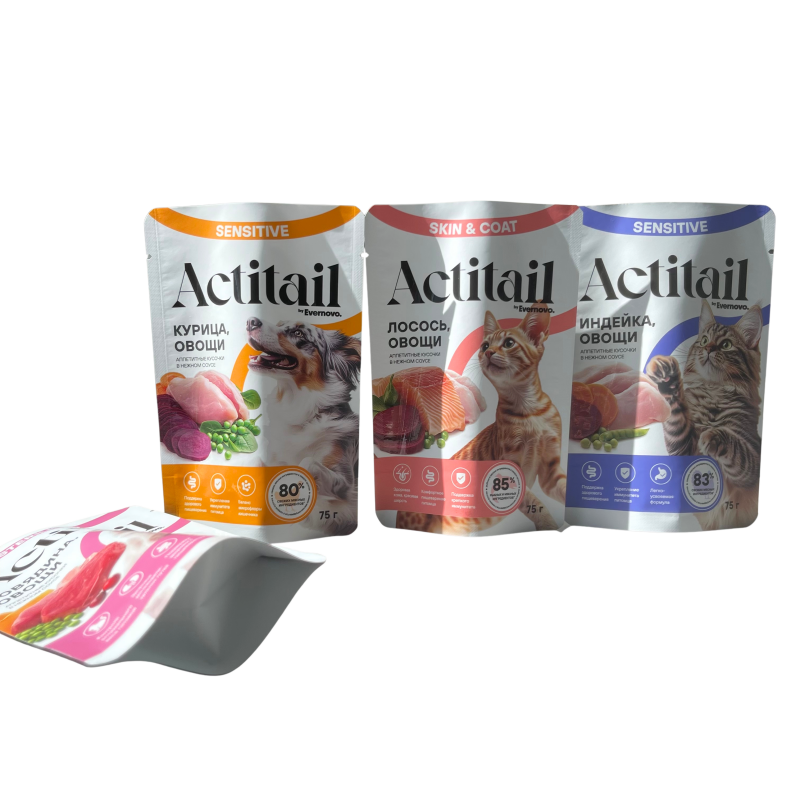
Aluminium and transparent retort structures are designed to address different packaging needs, so they should not simply be compared as better or worse. Aluminium foil structures are often selected when stronger light and gas barrier performance is required and product visibility is not necessary.
Transparent retort packaging is useful when showing the food itself is part of the package presentation, but it relies on a different combination of films and barrier technologies. The correct choice depends on the food, required protection, intended shelf life, desired appearance, storage conditions, and actual retort process.
A transparent pouch should not be selected only because the product looks attractive through the package, and aluminium foil should not be selected automatically because it appears to offer a higher level of protection. A better approach is to first define what the food needs the package to do and then select the structure that supports those requirements.
Assumption 6: If the Pouch Does Not Leak After Retort, the Packaging Has Passed
Leakage is one of the most obvious packaging failures, but it is not the only indicator of performance. A pouch may remain sealed while still showing other changes such as interlayer separation, excessive curling, wrinkling, surface distortion, seal deformation, reduced puncture resistance, or changes around folds.
Some performance issues are also difficult to identify visually. Seal strength and interlayer adhesion, for example, need to be evaluated through appropriate testing rather than judged only by appearance. Post-retort evaluation should therefore consider the package as a complete structure, including its seals, laminated layers, shape, and mechanical properties.
The question should not only be whether the pouch leaked, but whether the entire package still performs as intended after thermal processing.
Good Retort Packaging Decisions Start with the Actual Application
These six assumptions lead to the same conclusion: Retort Packaging cannot be judged by one specification alone. Temperature resistance, thickness, pouch dimensions, material type, and appearance all provide useful information, but none of them tells the full story by itself.
Food formulation, portion size, retort conditions, desired pouch shape, and storage requirements should be considered together. This becomes particularly important when an existing product changes. A new recipe, larger portion, different particle size, new pouch format, or revised thermal process may all justify another review of the original packaging structure.
Re-evaluating the packaging does not automatically mean that the pouch must be changed. It simply helps confirm whether the original structure still matches the new application conditions.
How Mfirstpack Supports Retort Packaging Projects
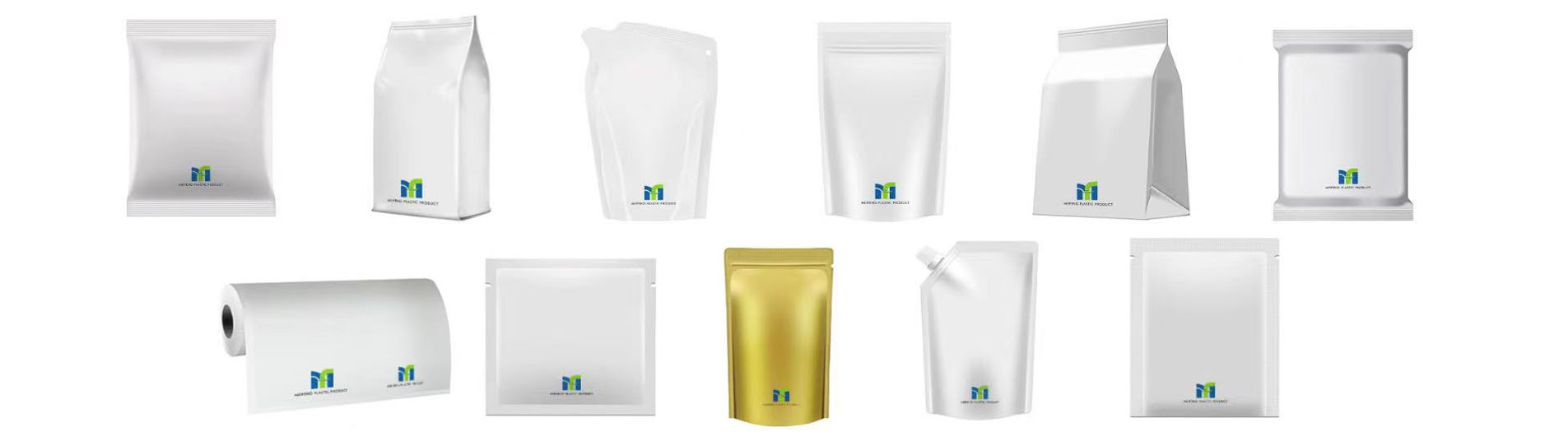
Mfirstpack provides retort packaging solutions for ready meals, meat, seafood, rice products, sauces, soups, pet food, and other thermally processed foods. Available options include aluminium retort pouches, transparent retort packaging, vacuum retort bags, three-side seal pouches, and stand-up retort formats.
Instead of relying only on pouch thickness or a fixed material specification, Mfirstpack can adjust pouch dimensions, structure, material combinations, printing, and finished appearance according to the actual food application. This makes it easier to match the package to different formulations, portion sizes, and processing requirements.
Quality evaluation can also include seal strength, interlayer adhesion, puncture resistance, burst strength, vacuum performance, tensile properties, drop resistance, and friction testing. These checks provide a broader view of packaging performance than visual inspection alone.
Reviewing an Existing Retort Packaging Structure?
If you are developing a new thermally processed food or changing the recipe, portion size, pouch format, or retort conditions of an existing product, it may be useful to review the current packaging structure before using it again without adjustment.
You can provide Mfirstpack with the food type, current pouch information, required size, retort conditions, artwork, and expected quantity. If a packaging problem has already appeared, information about when and where the issue occurs can also help identify the possible cause more efficiently.
Contact Mfirstpack to discuss a Retort Packaging solution based on the actual food, retort conditions, and finished package requirements.
FAQ
1. Is thicker Retort Packaging always stronger?
No. Total thickness is only one factor. Material combination, layer distribution, bonding quality, sealing performance, and mechanical properties also affect the final result.
2. Can one retort pouch structure be used for several food products?
It may be possible when the products and processing conditions are similar. However, significant differences in formulation, density, particle size, or thermal processing should be evaluated separately.
3. Can transparent Retort Packaging be used for high-temperature processing?
Yes, as long as the complete transparent structure is designed for the required retort conditions. Its barrier performance, seal integrity, and laminate stability should also meet the requirements of the intended application.
4. What can Mfirstpack test for Retort Packaging?
Depending on the project, testing can include seal strength, interlayer adhesion, puncture resistance, burst strength, vacuum performance, tensile properties, drop resistance, and friction performance.
Post time: Sep-22-2026