


Food packaging must protect products from contamination, preserve quality, and withstand filling, storage, and transportation. Choosing food grade bags for food packaging therefore involves more than selecting a material described as food-safe. The complete package must suit the food, the conditions of contact, and the way it will be handled throughout distribution. A structure suitable for dry snacks may not protect oily foods, coffee, or frozen products. The right choice balances food-contact suitability, barrier performance, sealing reliability, and strength.
Confirm Food-Contact Suitability Before Comparing Materials
“Food grade” is not a universal approval for every food and use. Whether a packaging material is suitable depends on the food’s composition, contact time, temperature, and the regulations in the destination market. A material intended for dry food at room temperature may not be appropriate for hot filling, acidic products, or frozen storage. Before choosing food grade bags for food packaging, identify whether the food is dry, oily, acidic, moist, or frozen, and whether it will be stored at room temperature, refrigerated, or frozen.
For multilayer packaging, consider the complete structure, including relevant layers, inks, adhesives, coatings, and closures. Request documentation for the proposed structure and intended conditions, and check it against the rules of the destination market. Quality-management certifications do not automatically prove that every packaging construction complies with food-contact regulations. The specific material and application still need to be verified.
Match Barrier Performance to the Food’s Main Quality Risks
Once food-contact suitability is established, consider what could damage the product during storage. Moisture, oxygen, light, and external odors affect different foods in different ways. Selecting a barrier based on the product’s actual risks is more useful than automatically choosing the highest-barrier structure.
Moisture barrier is important for crackers, biscuits, cereal, powdered ingredients, and dried fruit. Moisture absorption can soften crisp foods, cause powders to cake, or change texture. These products need a structure that limits moisture transmission over the expected storage period.
Oxygen barrier matters for products that are sensitive to oxidation, including nuts, seeds, coffee, and some snack foods. Exposure to oxygen can gradually affect flavor, aroma, and freshness. A suitable barrier layer can slow this process, but the required level depends on the food’s fat content, processing method, shelf-life target, and storage conditions.
Light protection may be necessary when a product is sensitive to light. Opaque or metallized structures can reduce light exposure, while transparent packaging lets customers see the contents. The choice should reflect both product-protection needs and display priorities.
Aroma retention and odor resistance also matter for coffee, tea, spices, and strongly flavored foods. Packaging should help retain desirable aromas and limit unwanted odor transfer during storage.
Select a Material Structure for the Specific Food Application
Different foods call for different combinations of flexibility, barrier performance, strength, and sealing behavior. A material structure should be selected according to the product and packaging process rather than by appearance or thickness alone.
| Food application | Key requirements | Packaging direction |
|---|---|---|
| Dry snacks and biscuits | Moisture control, reliable seals, handling strength | Flexible laminate suited to dry-food storage |
| Nuts and oily snacks | Oxygen control, grease resistance, aroma retention | Barrier structure compatible with oily products |
| Coffee and tea | Aroma retention, moisture and oxygen protection | High-barrier flexible packaging where required |
| Frozen food | Low-temperature flexibility, seal strength, puncture resistance | Structure tested for frozen conditions |
| Powdered food | Moisture control, leak prevention, dependable seals | Suitable barrier bag with secure closure |
These are starting points, not fixed specifications. Final selection should account for product composition, package size, shelf life, filling conditions, and destination market.
A multilayer structure may combine printable, barrier, and sealing layers. More layers do not automatically mean better performance; each should serve a clear purpose, and the complete structure should be checked for bonding and sealing.
Evaluate Durability Beyond Film Thickness
Packaging can meet food-contact and barrier requirements yet still fail during filling or distribution. Punctures, tears, weak seals, and deformation may occur when bags are filled, stacked, moved, or transported.
Film thickness contributes to strength, but it is only one factor. Resin properties, layer composition, pouch dimensions, corner design, seal width, and the weight of the packed food all influence performance. A heavier product may need stronger film and a structure that distributes load effectively. A pouch with sharp or hard contents may require additional puncture resistance.
Seal integrity deserves particular attention. A strong film cannot compensate for an unreliable seal. Food residue in the sealing area, unsuitable temperature, insufficient pressure, or incorrect dwell time can create weak points and leakage. Sealing settings should be checked using the actual packaging material and production equipment.
Testing may include seal-strength and leak checks, drop or compression tests, and inspection after storage at the intended temperature. This shows whether the complete package can withstand normal handling.
Choose a Bag Format That Works With the Product and Equipment
Bag format affects filling efficiency, shelf presentation, storage, and consumer use. It should be chosen alongside the material structure because the shape and opening of a package influence how it performs on the production line.
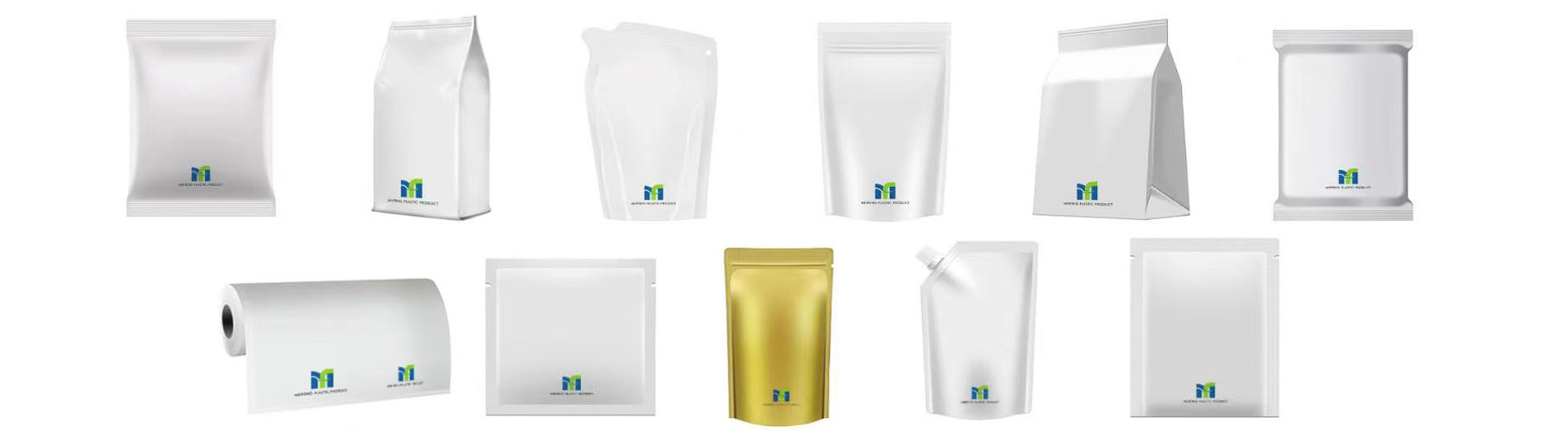
- Stand-up pouches provide a stable base for shelf display and are used for products such as snacks, dried foods, and coffee. Zippers or tear notches may be added when they suit the product and use pattern.
- Flat pouches are often suitable for smaller portions, samples, and products that do not need a self-standing base.
- Side-gusset bags expand to provide additional capacity and are often considered for coffee and larger-volume products.
- Roll film is designed for packaging lines that form, fill, and seal bags automatically. Film properties and dimensions must match the machine.
Confirm bag dimensions, opening size, gussets, and sealing area before production. The package must feed, open, fill, and seal consistently. A sample may look suitable but still cause line problems if its flexibility or dimensions do not match the equipment.
Test Samples Before Moving to Mass Production
Test samples with the actual food, filling method, and sealing settings. Check opening, filling, seal consistency, and package shape after filling.
Consider storage and distribution too: stacking, temperature changes, and extended storage can affect package performance. Evaluate barrier properties against the product’s shelf-life target.
Before approving a specification, confirm the food type and net weight, shelf-life target, required barrier properties, material documentation, bag dimensions, closure features, printing, order quantity, and expected storage conditions. A clear specification reduces misunderstandings and makes sample evaluation more meaningful.
Base Customization on Functional Requirements
Custom food grade bags for food packaging can be adjusted in material combination, dimensions, pouch style, printing, and functional details such as zippers or tear notches. These options should solve a defined packaging need rather than be added simply because they are available.
Start with the food type, weight, sensitivity, filling method, shelf-life target, storage temperature, and sales market. These details help determine the suitable structure and format.
Mfirstpack offers flexible packaging formats and material structures, including stand-up pouches, flat-bottom bags, side-gusset bags, and roll films. These options can be considered according to the product’s protection requirements and filling conditions, with the final construction confirmed through sample evaluation.
Conclusion
Choosing food grade bags for food packaging means matching food-contact suitability, barrier properties, durability, bag format, and filling conditions. No single material or pouch style is right for every food. Define the product’s risks and storage requirements first, verify the relevant documentation, and test the complete package before mass production. This process helps protect food quality while reducing avoidable packaging and production problems.
FAQs
1. Are all food grade bags suitable for every food product?
No. Suitability depends on food composition, contact conditions, temperature, packaging construction, and the regulations in the destination market.
2. Which barrier properties are most important in food packaging?
Moisture and oxygen control are common priorities. Light protection, grease resistance, and aroma retention may also be important depending on the food.
3. Can food packaging bags be customized?
Yes. Material structure, dimensions, pouch format, printing, and features such as zippers can be selected according to product and production requirements.
4. Why should packaging samples be tested before mass production?
Testing helps confirm material suitability, filling and sealing compatibility, seal integrity, and durability under expected storage and transportation conditions.
Post time: Nov-24-2026